Though both are used to exclude rows from the result set, you should use the WHERE clause to filter rows before grouping and use the HAVING clause to filter rows after grouping. In other words, WHERE can be used to filter on table columns while HAVING can be used to filter on aggregate functions like count, sum, avg, min, and max. Expression_n Expressions that are not encapsulated within an aggregate function and must be included in the GROUP BY Clause at the end of the SQL statement. Aggregate_function This is an aggregate function such as the SUM, COUNT, MIN, MAX, or AVG functions. Aggregate_expression This is the column or expression that the aggregate_function will be used on. There must be at least one table listed in the FROM clause.

These are conditions that must be met for the records to be selected. The expression used to sort the records in the result set. If more than one expression is provided, the values should be comma separated. ASC sorts the result set in ascending order by expression. DESC sorts the result set in descending order by expression. Knowing how to use a SQLGROUP BY statement whenever you have aggregate functions is essential.

In most cases, when you need an aggregate function, you must add aGROUP BY clause in your query too. The first must contain a distinct first name of the employee and the second – the number of times this name is encountered in our database. The GROUP BY clause groups a set of rows into a set of summary rows by values of columns or expressions. In other words, it reduces the number of rows in the result set. ROLLUP is an extension of the GROUP BY clause that creates a group for each of the column expressions.

Additionally, it "rolls up" those results in subtotals followed by a grand total. Under the hood, the ROLLUP function moves from right to left decreasing the number of column expressions that it creates groups and aggregations on. Since the column order affects the ROLLUP output, it can also affect the number of rows returned in the result set.

The SUM() function returns the total value of all non-null values in a specified column. Since this is a mathematical process, it cannot be used on string values such as the CHAR, VARCHAR, and NVARCHAR data types. When used with a GROUP BY clause, the SUM() function will return the total for each category in the specified table. The OVER clause defines a window or user-specified set of rows within a query result set.

A window function then computes a value for each row in the window. You can use the OVER clause with functions to compute aggregated values such as moving averages, cumulative aggregates, running totals, or a top N per group results. The OMIT RECORD IF clause is a construct that is unique to BigQuery. It is particularly useful for dealing with nested, repeated schemas. It is similar to a WHERE clause, but different in two important ways. First, it uses an exclusionary condition, which means that records are omitted if the expression returns true, but kept if the expression returns false or null.

Second, the OMIT RECORD IF clause can use scoped aggregate functions in its condition. It filters non-aggregated rows before the rows are grouped together. To filter grouped rows based on aggregate values, use the HAVING clause. The HAVING clause takes any expression and evaluates it as a boolean, just like the WHERE clause. As with the select expression, if you reference non-grouped columns in the HAVINGclause, the behavior is undefined.

In the result set, the order of columns is the same as the order of their specification by the select expressions. If a select expression returns multiple columns, they are ordered the same way they were ordered in the source relation or row type expression. Each window function requires an OVER clause that specifies the window top and bottom. The three components of the OVERclause provide additional control over the window. Partitioning enables you to divide the input data into logical groups that have a common characteristic.

Ordering enables you to order the results within a partition. Framing enables you to create a sliding window frame within a partition that moves relative to the current row. You can configure the size of the moving window frame based on a number of rows or a range of values, such as a time interval.

You can use either numeric or string expressions as arguments for comparison functions. (String constants must be enclosed in single or double quotes.) The expressions can be literals or values fetched by a query. Comparison functions are most often used as filtering conditions in WHERE clauses, but they can be used in other clauses. The LIMIT clause will stop processing and return results when it satisfies your requirements.

The Group by clause is often used to arrange identical duplicate data into groups with a select statement to group the result-set by one or more columns. This clause works with the select specific list of items, and we can use HAVING, and ORDER BY clauses. Group by clause always works with an aggregate function like MAX, MIN, SUM, AVG, COUNT.
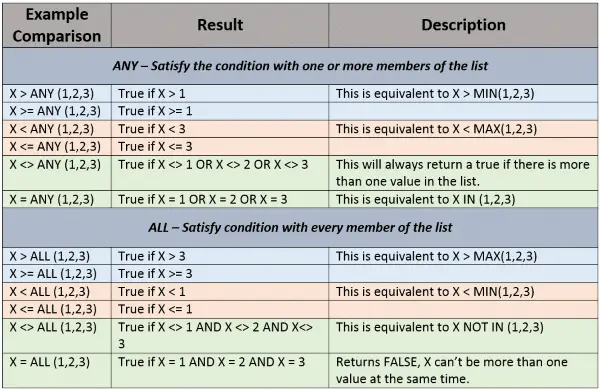
Specifies the expressions that are used to group the rows. This is used in conjunction with aggregate functions (MIN, MAX, COUNT, SUM, AVG, etc.) to group rows based on the grouping expressions and aggregate values in each group. When a FILTER clause is attached to an aggregate function, only the matching rows are passed to that function.
Statement reads one or more columns for one or more rows in a table. It returns a result-set of the rows matching the request, where each row contains the values for the selection corresponding to the query. Additionally, functions, including aggregation ones, can be applied to the result. The WHERE clause in MySQL is used with SELECT, INSERT, UPDATE, and DELETE queries to filter data from the table or relation. It describes a specific condition when retrieving records from a single table or multiple tables using the JOIN clause. If the specified condition is satisfied, it returns the particular value from the table.

The WHERE clause places conditions on the selected columns. The WHERE clause, sometimes called the predicate, filters records produced by the FROM clause using a boolean expression. Multiple conditions can be joined by boolean AND and OR clauses, optionally surrounded by parentheses—()— to group them.

Like most things in SQL/T-SQL, you can always pull your data from multiple tables. Performing this task while including a GROUP BY clause is no different than any other SELECT statement with a GROUP BY clause. The fact that you're pulling the data from two or more tables has no bearing on how this works. In the sample below, we will be working in the AdventureWorks2014 once again as we join the "Person.Address" table with the "Person.BusinessEntityAddress" table. I have also restricted the sample code to return only the top 10 results for clarity sake in the result set. The GROUP BY clause is often used with aggregate functions such as AVG(), COUNT(), MAX(), MIN() and SUM().
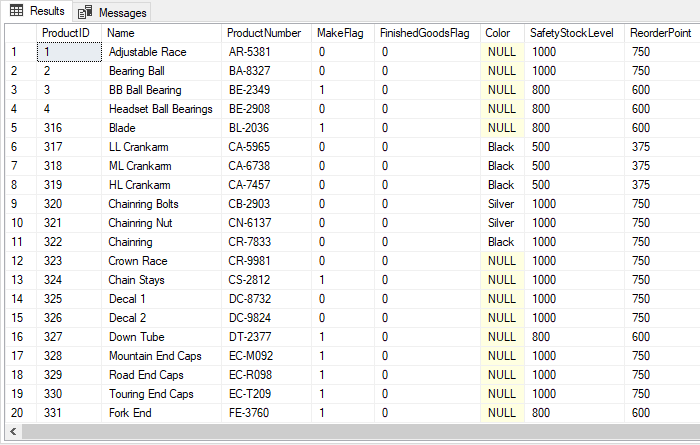
In this case, the aggregate function returns the summary information per group. For example, given groups of products in several categories, the AVG() function returns the average price of products in each category. The SELECT statement used in the GROUP BY clause can only be used contain column names, aggregate functions, constants and expressions.
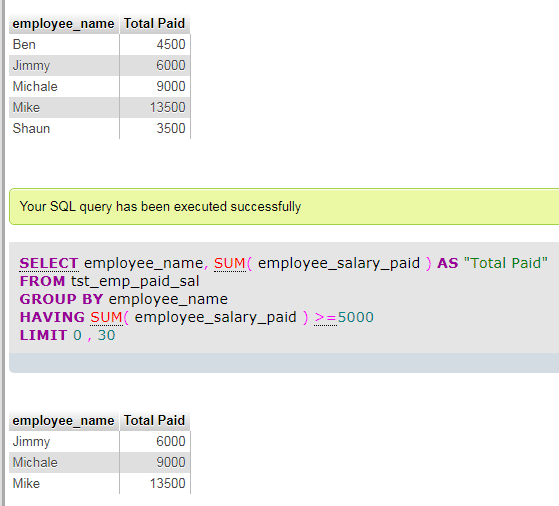
The GROUP BY clause is a SQL command that is used to group rows that have the same values. Optionally it is used in conjunction with aggregate functions to produce summary reports from the database. You can use the SQL PARTITION BY clause with the OVER clause to specify the column on which we need to perform aggregation. PARTITION BY gives aggregated columns with each record in the specified table. If we have 15 records in the table, the query output SQL PARTITION BY also gets 15 rows.

On the other hand, GROUP BY gives one row per group in result set. When querying multiple tables, use aliases, and employ those aliases in your select statement, so the database doesn't need to parse which column belongs to which table. Note that if you have columns with the same name across multiple tables, you will need to explicitly reference them with either the table name or alias. ROWS - Defines a window in terms of row position, relative to the current row.

For example, to add a column showing the sum of the preceding 5 rows of salary values, you would query SUM OVER . The set of rows typically includes the current row, but that is not required. COVAR_POP Computes the population covariance of the values computed by numeric_expr1 and numeric_expr2. COVAR_SAMP Computes the sample covariance of the values computed by numeric_expr1 and numeric_expr2. EXACT_COUNT_DISTINCT Returns the exact number of non-NULL, distinct values for the specified field. FIRST Returns the first sequential value in the scope of the function.

GROUP_CONCAT('str' ) Concatenates multiple strings into a single string, where each value is separated by the optional separator parameter. If separator is omitted, BigQuery returns a comma-separated string. CROSS JOINcan return a large amount of data and might result in a slow and inefficient query or in a query that exceeds the maximum allowed per-query resources. When possible, prefer queries that do not use CROSS JOIN. For example, CROSS JOIN is often used in places where window functions would be more efficient. The WITHIN keyword causes the aggregate function to aggregate across repeated values within each record. For every input record, exactly one aggregated output will be produced.

This type of aggregation is referred to as scoped aggregation. Since scoped aggregation produces output for every record, non-aggregated expressions can be selected alongside scoped-aggregated expressions without using a GROUP BY clause. The aggregate functions allow you to perform the calculation of a set of rows and return a single value. The GROUP BY clause is often used with an aggregate function to perform calculations and return a single value for each subgroup. Contrary to what most books and classes teach you, there are actually 9 aggregate functions, all of which can be used with a GROUP BY clause in your code. As we have seen in the samples above, you can have a GROUP BY clause without an aggregate function as well.

As we demonstrated earlier in this article, the GROUP BY clause can group string values also, so it doesn't always have to be a numeric or date value. Adding a HAVING clause after your GROUP BY clause requires that you include any special conditions in both clauses. If the SELECT statement contains an expression, then it follows suit that the GROUP BY and HAVING clauses must contain matching expressions. It is similar in nature to the "GROUP BY with an EXCEPTION" sample from above.

In the next sample code block, we are now referencing the "Sales.SalesOrderHeader" table to return the total from the "TotalDue" column, but only for a particular year. IIt is important to note that using a GROUP BY clause is ineffective if there are no duplicates in the column you are grouping by. A better example would be to group by the "Title" column of that table. The SELECT clause below will return the six unique title types as well as a count of how many times each one is found in the table within the "Title" column.

This statement will return an error because you cannot use aggregate functions in a WHERE clause. WHERE is used with GROUP BY when you want to filter rows before grouping them. The GROUP BY clause is used in a SELECT statement to group rows into a set of summary rows by values of columns or expressions. The SQL standard requires that HAVING must reference only columns in the GROUP BYclause or columns used in aggregate functions. However, MySQL supports an extension to this behavior, and permits HAVING to refer to columns in the SELECT list and columns in outer subqueries as well.

While the first query is not needed, I've used it to show what it will return. You can use any of the grouping functions in your select expression. Their values will be calculated based on all the rows that have been grouped together for each result row.

If you select a non-grouped column or a value computed from a non-grouped column, it is undefined which row the returned value is taken from. This is not permitted if the ONLY_FULL_GROUP_BY SQL_MODE is used. When you use a GROUP BY clause, you will get a single result row for each group of rows that have the same value for the expression given in GROUP BY. In conclusion, we didn't say that the SQLGROUP BY clause is one of the most powerful tools out there for no reason. It is preferred over the SELECT DISTINCT statement because it can be combined with aggregate functions. You can also use it with SQLORDER BY. However, you must make sure that you keep the right order when writing it.

But this technique is constantly being applied in queries, as it clarifies the analysis undertaken. If you are interested in learning about what else you can combine with the GROUP BY statement, you can learn all about the HAVING clause. The window frame syntax supports additional clauses for row pattern recognition.
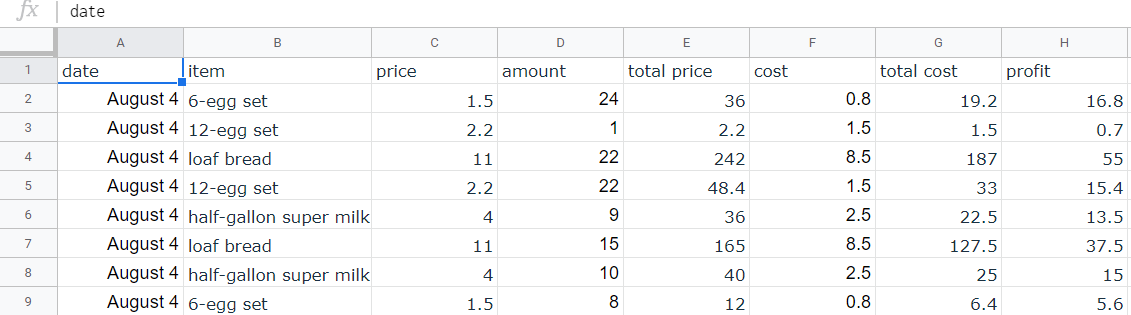
If the row pattern recognition clauses are specified, the window frame for a particular row consists of the rows matched by a pattern starting from that row. Additionally, if the frame specifies row pattern measures, they can be called over the window, similarly to window functions. For more details, seeRow pattern recognition in window structures. The GROUP BY clause lets you group rows that have the same values for a given field or set of fields so that you can compute aggregations of related fields. Grouping occurs after the filtering performed in the WHERE clause but before the expressions in the SELECT clause are computed. The expression results cannot be used as group keys in the GROUP BY clause.

The term table wildcard function refers to a special type of function unique to BigQuery. These functions are used in the FROM clause to match a collection of table names using one of several types of filters. For example, the TABLE_DATE_RANGE function can be used to query only a specific set of daily tables. For more information on these functions, see Table wildcard functions.
In this syntax, you place the GROUP BY clause after the FROM and WHERE clauses. After the GROUP BY keywords, you place is a list of comma-separated columns or expressions to group rows. The MIN() function returns the smallest value in the column specified. In the first SELECT statement, we will not do a GROUP BY, but instead, we will simply use the ORDER BY clause to make our results more readable sorted as either ASC or DESC. However, you can use the GROUP BY clause with CUBE, GROUPING SETS, and ROLLUP to return summary values for each group. FILTER is a modifier used on an aggregate function to limit the values used in an aggregation.